
May 6, 2026 — Burleson, TX
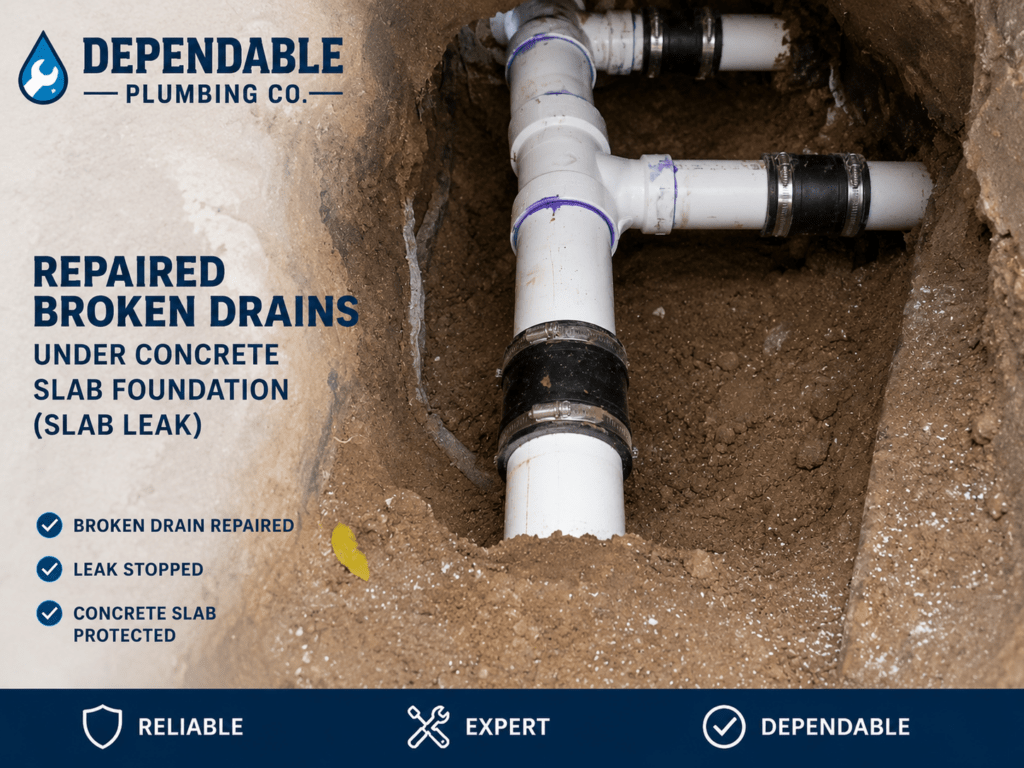
When a homeowner in Burleson started noticing slow drains and a faint sewer smell that wouldn’t go away, the cause turned out to be exactly what we suspected: a section of the original cast iron drain line had failed under the concrete slab foundation. Don tunneled down to the bad section, removed the corroded pipe, and rebuilt the line with new PVC — restoring proper drainage without breaking up the slab.
Why Cast Iron Drains Fail Under Slab Foundations
Cast iron was the standard residential drain material for decades, and plenty of older Burleson homes still have it underground. The problem is that cast iron has a finite lifespan, especially when buried in the clay-heavy soil that runs through North Texas. Over the years the pipe corrodes from the inside out and the outside in, until sections crack, separate at the joints, or rust through entirely.
The piece we pulled from this job tells the story plainly. The pipe wall had eaten through in multiple spots and the joints had completely lost their seal. Once that happens, wastewater starts seeping into the soil beneath the foundation instead of flowing out to the city sewer line.
How We Repaired the Broken Drain
Replacing a failed drain section under a slab takes more than a quick patch. Here’s what the job involved:
- Locating the failure point precisely so excavation stayed minimal
- Tunneling under the slab to expose the broken section without cutting concrete
- Removing the failed cast iron length from the work area
- Installing new PVC pipe and fittings sized for the existing system
- Connecting the new PVC to the sound pipe with heavy-duty rubber couplings
- Pressure-testing the connection before backfilling the trench
The replacement PVC won’t corrode the way cast iron does and is rated for the same waste flow as the original line. With proper installation, this section should outlast the rest of the home’s drain system by a wide margin.
Signs You May Have a Broken Drain Under Your Slab
Most under-slab drain failures don’t announce themselves with a dramatic flood. The early warning signs are usually subtle:
- Slow drains throughout the home that don’t respond to standard drain cleaning
- Sewer odors inside the house with no obvious source
- Damp spots, warm patches, or unexplained moisture on the slab floor
- Hairline cracks in the slab or interior walls along the drain line route
- Rising water bills if a pressure line is leaking nearby as well — which can point to a related slab leak issue
If any of those sound familiar, get the line inspected before the damage starts compromising the foundation.
Need a plumber today? Call 817-447-2654 — phones are answered around the clock and we’ll get someone scheduled fast.
Why Tunneling Beats Cutting the Slab
The shortcut on a job like this is tempting: bust open the slab, swap the section, pour new concrete, move on. But cutting and re-pouring slab unnecessarily weakens the foundation, costs the homeowner more, and leaves a visible patch in the floor.
Tunneling preserves the slab. It takes more skill and more time, but the home is left structurally intact and the floor finish stays original. That matters for resale value and for the long-term integrity of the foundation itself.
Dependable Plumbing has been doing under-slab work in South DFW since 1985. Other plumbers regularly call us in when they can’t find or reach a slab issue themselves. If you’re seeing the early signs of a drain failure under your foundation, the sooner we take a look, the less invasive the fix tends to be.
Schedule Under-Slab Drain Repair in South DFW
Call 817-447-2654 to schedule service. Dependable Plumbing has been serving Burleson, Crowley, Joshua, Everman, Alvarado, Arlington, Fort Worth, Keene, Mansfield, Kennedale, Rendon, Godley — and surrounding South DFW communities — since 1985. Master License M12423.
Need a plumber? Call Don.
Same-day service on most plumbing calls · Licensed Plumber
817-447-2654